 OrOn
OrOnRecords write themselves
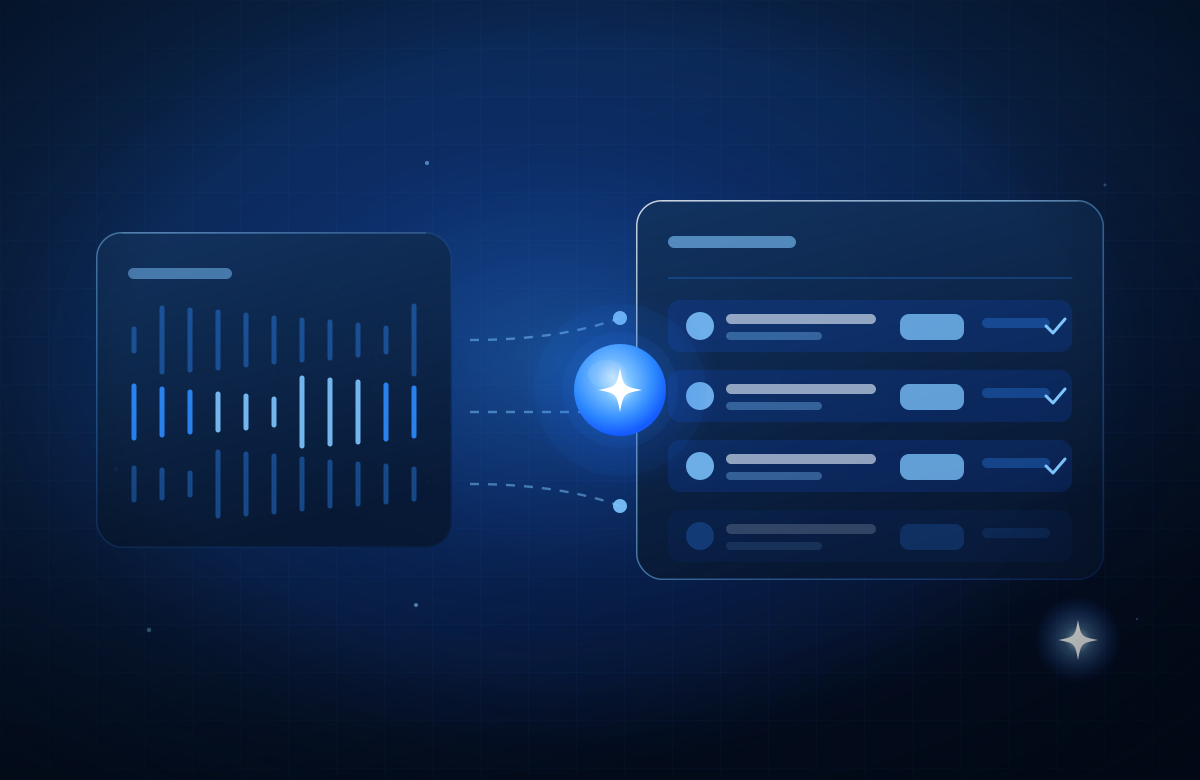
The record exists before the rep has put the phone down. Contact, company, intent, objection, budget signal, competitor mentioned, outcome, extracted from what was actually said, not from what someone remembered.
Every CRM ever sold has the same failure mode: it depends on a tired person typing up a call they finished ten minutes ago. So the notes are thin, the fields are empty and the forecast is fiction. This one listens to the conversation and writes the record itself, while the call is still happening.
The reason a pipeline review feels like archaeology is not the software. It is that the richest data your company produces, hundreds of hours of customers explaining exactly what they want and why they hesitate, evaporates the moment the call ends. What survives is a three-word note typed at 18:55.
The record exists before the rep has put the phone down. Contact, company, intent, objection, budget signal, competitor mentioned, outcome, extracted from what was actually said, not from what someone remembered.
Each extracted value carries a confidence score and a link to the exact second it came from. Disagree with a field and you listen to the four seconds that produced it, rather than arguing about it.
“Send me the pricing on Thursday” turns into a scheduled task with an owner and a due date, and where you allow it, the quote goes out on its own.
Pipeline scoring built on what buyers said, not on how optimistic the rep felt on Friday. Slipped deals come with the sentence where they slipped.
“Which deals mentioned our competitor this month?” is a question, not a report request. The answer arrives with the calls it is based on.
Writes into Salesforce, HubSpot or Dynamics through the integration layer, or becomes the system of record, so nobody maintains field mappings any more.
Live OrOn calls write in real time. Existing recordings from mobile, Teams, Zoom or your contact centre are ingested the same way.
OrOn calls stream in live. Any other recorded channel is ingested and processed identically.
Your objects, your schema, your definition of a qualified lead. Set the confidence threshold for automatic writes.
Speech is transcribed, diarised and structured in flight. Entities, intent, objections and commitments are extracted as they are said.
Written, scored, linked to audio, with the next step already scheduled. Anything below threshold is queued for one-click review.
Move the sliders to your numbers. This counts only the typing, not the deals lost to data that was never captured, which is the larger number and the harder one to model.
Based on 220 working days. Assumes the admin is actually done, where it is skipped, the cost moves from payroll into forecast accuracy.
Either. Most customers start with it beside their existing CRM, the agent writes into Salesforce or HubSpot through the integration layer, and the AI Native CRM is where the conversation-level truth lives. Teams that are tired of paying per seat for a database nobody fills tend to migrate fully within two quarters.
Every extracted field carries a confidence score with a link to the exact second of audio it came from. Anything below your threshold is flagged for one-click review instead of being written silently, wrong data in a CRM is worse than missing data.
Any recorded call can be ingested, mobile, Teams, Zoom, your existing contact centre. The agent processes it the same way. Live OrOn calls simply write in real time instead of after the fact.
It proposes one and, where you allow it, executes it: schedules the callback, sends the quote, opens the ticket, sets the reminder. Every automated action is policy-bound and logged, and you choose which ones need a human to confirm.
You talk to the CRM. “Which deals slipped this week and why?” returns the answer with the calls it is based on, because the reasons were said out loud on those calls and captured, not typed into a free-text note by whoever remembered.
Cloud, private VPC or fully on-premise. Fields can be redacted at capture, retention is configurable per field, and access is role-based with a complete audit trail. Regulated deployments run entirely inside your network.
Running alongside an existing CRM takes days. A full migration is typically four to eight weeks depending on how much history and custom objects come across, we map the schema in week one and run both in parallel until you switch.
Send us a recording under NDA, or book twenty minutes and we will run it live. Either way you see the structured output before you commit to anything.
Contact UsTwo minutes. We reply within one business day.
Your enquiry landed with our sales team. We reply within one business day.