 OrOn
OrOnInput, VAD and STT
Audio arrives over SIP or WebRTC. Voice activity detection separates speech from noise and silence; streaming speech-to-text transcribes continuously rather than waiting for the caller to finish.
Every turn travels the same path: capture, understand, decide, speak, with context and long-term memory attached at the core. Nothing is a black box, because when a call goes wrong you need to know which stage caused it.
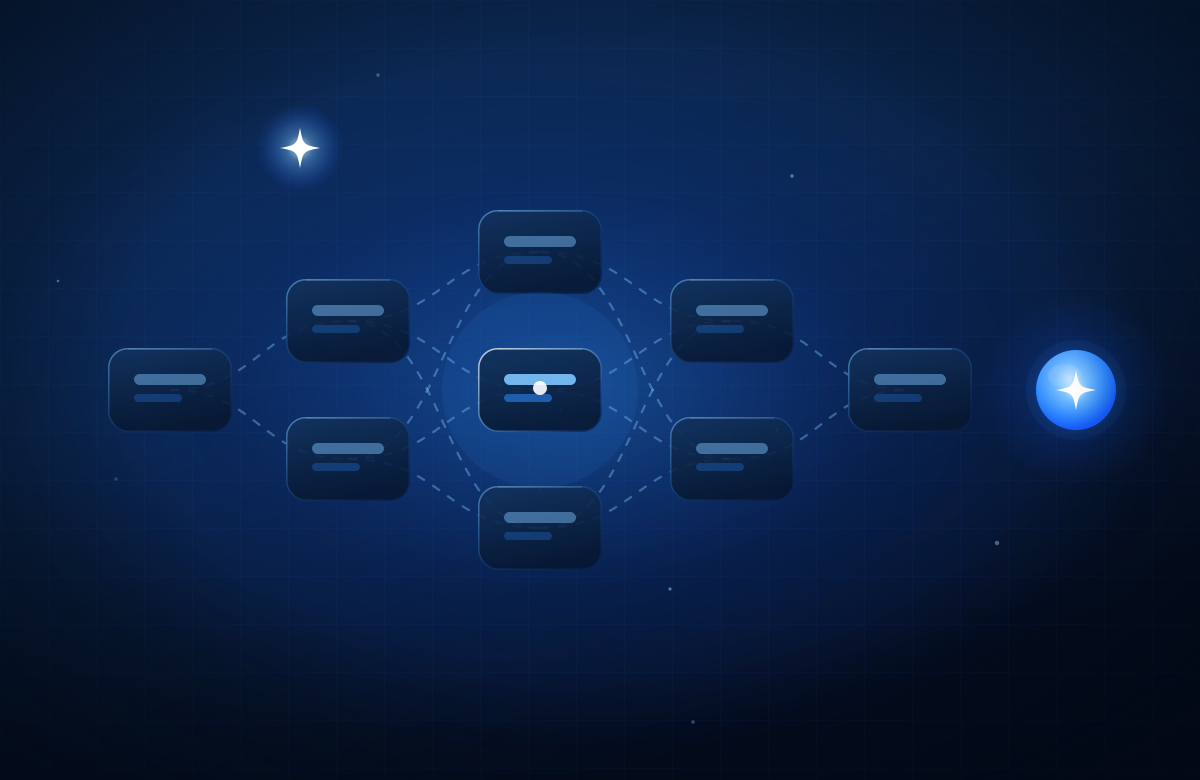
Explore the same pipeline as an interactive 3D model on the home page, drag to rotate, and switch between cloud and on-premise topology.
Audio arrives over SIP or WebRTC. Voice activity detection separates speech from noise and silence; streaming speech-to-text transcribes continuously rather than waiting for the caller to finish.
The core. It holds conversation state, applies your business rules, decides whether to answer, ask, act or escalate, and calls external systems mid-conversation.
Retrieval over your documents and policies plus session history and, where permitted, long-term caller memory synced with your CRM.
Runs in parallel on the live audio, feeding frustration and urgency signals into escalation decisions rather than into a report nobody reads.
A fast conversational voice for interactive turns and a high-fidelity path for narration or recorded output, chosen per utterance.
Noise reduction, equalisation and level control before the synthesised audio returns to the telephony leg.
The same eleven components, three different perimeters. The toggle on the home page shows the topology change.
Fastest to deploy. We operate the infrastructure; you get an endpoint and a dashboard.
The stack runs inside your cloud account and network boundary, managed jointly.
Everything on your hardware. No external calls, air-gap capable, standard for government and defence.
Reasoning on-premise with elastic cloud burst for non-sensitive workloads, where policy permits.
Yes, the pipeline is deliberately model-agnostic. Speech recognition, reasoning and synthesis are separate stages with defined interfaces, so a deployment can use open-weight models on-premise or commercial APIs in the cloud without changing the agent logic.
Each stage has a defined fallback: degraded-mode recognition, a smaller local reasoning model, or a scripted safe response followed by transfer to a human. A failure produces a graceful handover, not a dropped call.
Every turn is logged with its inputs, outputs, latency and confidence at each stage. You can replay a call and see exactly where understanding broke down, recognition, intent, retrieval or generation.
Horizontally. Peak load is absorbed by adding stateless workers; conversation state lives outside the compute layer.
Yes. The same components and the same agent behaviour, with the model selection tuned for the hardware available. The interactive model on our home page shows the topology difference between cloud and on-premise.
Tell us the use case and the volume. We come back within one business day with a scoped pilot, a timeline and a number.
Contact UsTwo minutes. We reply within one business day.
Your enquiry landed with our sales team. We reply within one business day.